The Business Problem & What I Learned:
With numerous pharmaceutical production sites around the world, AstraZeneca was looking for a way to increase the efficiencies of those complex processes, maintain quality standards, and replace a previous quality-control system performing far below expectations.
User Pain Points & Business Impacts:
-

Slow Reaction Times
Production lines depended completely on manual communication & intervention, severely limiting the ability to avoid developing problems, leading to avoidable productivity & materials loss.
-

Lengthy Investigations
Investigations into the cause(s) of line issues needed to be manually performed with a broken solution, increasing line downtime & investigative effort, reduced productivity, and increased long-term costs.
-

Limited Ability to Learn & Share
Once investigations were complete, there was no ready way for users to share that information between facilities, allowing issues to repeat across sites, limiting the ability to avoid them, and creating repetitive work.
Project Context & Design Strategy:
With an initial effort stalled in the discovery phase, I needed to move quickly to create alignment and trust between users, stakeholders, and the product team. By introducing comprehensive primary & secondary research to encourage ideation and inform product requirements, we quickly surfaced:
Identified Issues:
-
A Highly Regulated Space
Any solution had to meet FDA requirements (cGMP/GAMP 5, and 21 CFR Parts 11 & 211) to be successful.
-

A Previous Solution that Slowed Overall Workflow
The previous solution created severe bottlenecks that pushed KPIs into the red.
-

Ignored User Needs created a Lack of Strategic Clarity
Requirements were being sought without mapping user needs, or examining the overall context.
-

Stakeholder Skepticism increased Felt Pressure
With mounting costs and no clear approach, a lack of stakeholder confidence put the project at risk.
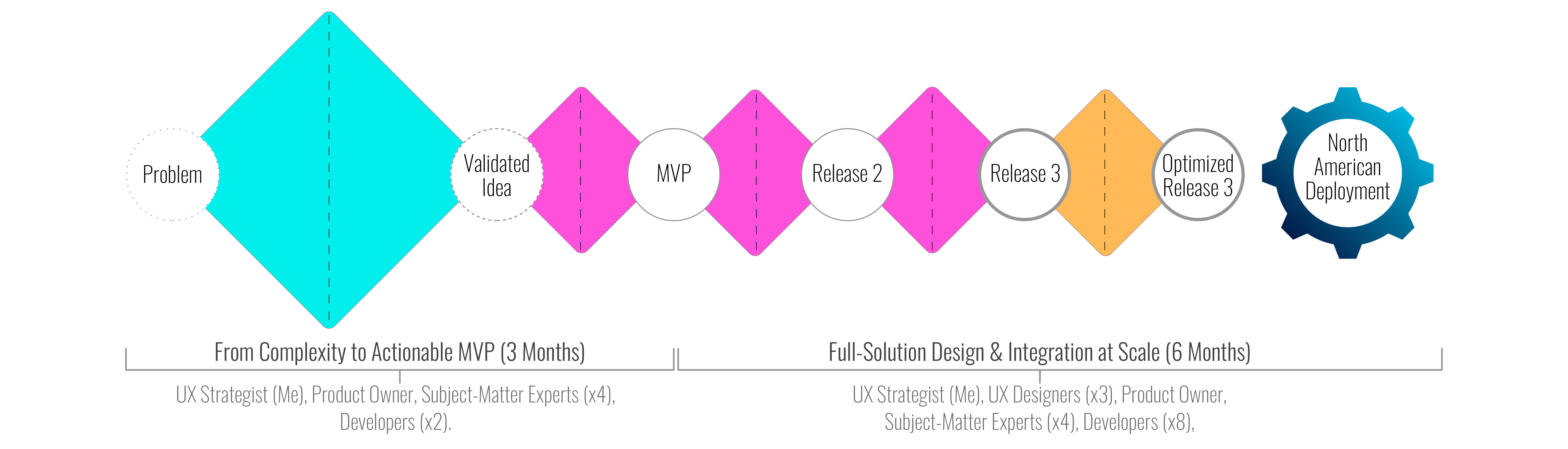
Our goal was to rapidly determine clear requirements for a solution that users found robust, dependable, and effective, and that could be feasibly delivered to FDA standards. Using an AgileFall UX design strategy (i.e. detailed research with iterative design), we regained momentum and delivered a full-solution ahead of schedule.
What We Shipped & The Impact:
Within 9 months (12 weeks ahead of schedule), we designed and delivered a modular AI-enabled QC system that addressed discovered user pain points, met all regulatory compliance standards (FDA’s cGMP/GAMP 5, and 21 CFR Parts 11 & 211), and delivered significant business value across North America:
Outcome #1: Faster User Reaction Times through Continuous Monitoring
By providing users the ability to continuously monitor all aspects of the production process, we were able to:
- Reduce line stoppage incidents by over 50%.
- Reduce materials wastage, lowering production costs by 12% ($1M per month, 6 sites).
- Increase overall line productivity by 17%.

Outcome #2: Speedier Investigations leveraging AI Assistance
By providing users the ability to continuously monitor all aspects of the production process, we were able to:
- Reduce investigation time by an average of 65%.
- Increase line up-time between 14-20% (depending on location).
Outcome #3: Shared Learning & Cooperative Investigations across Production Sites
Provided users with in-system investigation library and AI issue summary offering potential solutions that resulted in:
- Reduced incident repetition by over 80% across North America.
- Increased investigative collaboration across production sites.
Outcome #4: Continuous Process Improvement enabled by AI “Watchdog”
By utilizing incoming line data to detect issues as they were forming, users were able to:
- Identify & adapt for potential issues during line setup.
- Increase effective, cGMPS-compliant line oversight through by Human/AI partnership.