The Business Problem & What I Learned:
With an industry-leading cancer research platform, the Oncology Data Science Platforms (ODSP) group was interested in a smoother research workflow for greater efficiency. After rapid research surfaced additional opportunities for commercial applications, my work was extended to solve for those challenges.
User Pain Points & Business Impacts:
-

Slow Onboarding & High Support Costs
While technically impressive, the research software lacked any consideration for usability, forcing users to memorize workflows by rote, frequently request in-depth support, and generally slowed research workflows.
-

Infrequent, Problematic Edge Cases
Trained on limited patient data (HIPAA-anonymized), the system would occasionally return misleading results, increasing stress on pathologists’ peer review process and introducing the chance of serious mistakes.
-

Limited Applicability & Results
Initial AI training had yielded a valuable research tool, but there was frustration amongst users that this functionality couldn’t be significantly expanded without a clear AI training strategy, limiting the yield on costly research.
Project Context & Design Strategy:
Initially tasked to provide a simple usability review, my research surfaced additional opportunities that I included in my presentation to product stakeholders:
Identified Issues:
-

Shifting Regulatory Environments
The team was exploring a potential commercial context (CDS/SaMD) for a “research use only” (RUO) tool.
-

Problematic AI Results
The QCS AI system could return infrequently ambiguous results that manual peer review needed to catch.
-

HIPAA-Compliant Data Scope
To improve the scanning of whole-slide images (WSI), a wider pipeline of data was needed without violating patient privacy.
-

Lack of Usability reduced Research Efficiency
Catering to functionality first, users took longer to onboard and frequently needed support.
What began as a scoped usability review surfaced a larger regulatory and commercial opportunity, prompting an extended engagement to help the team think through what this platform could become, not just how to fix its interface.
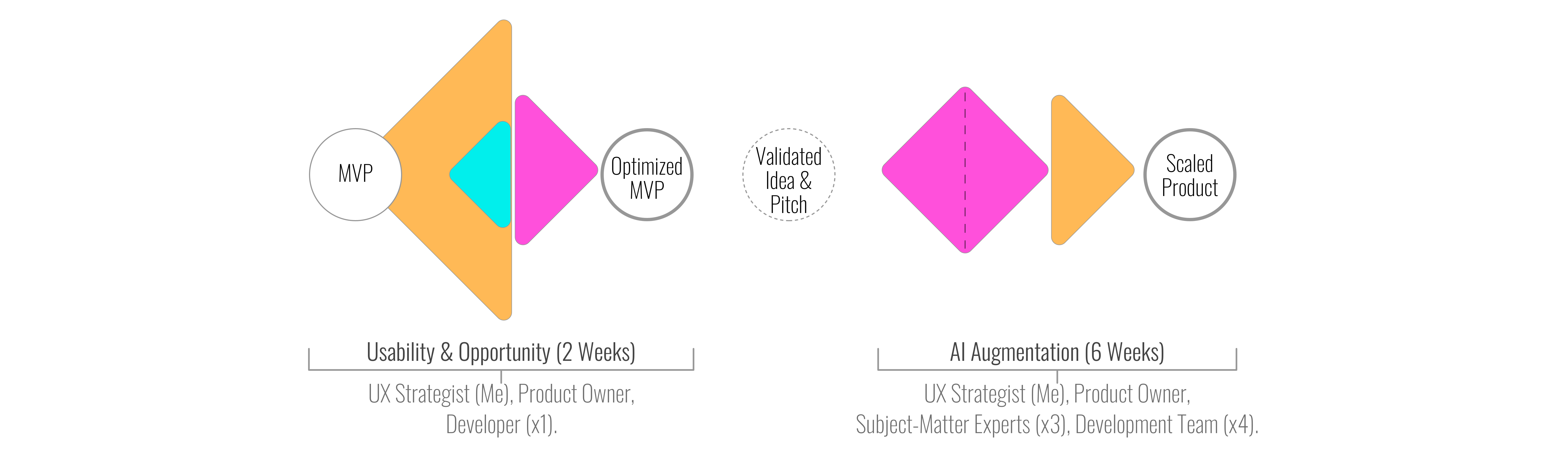
What We Delivered & The Impact:
Starting with an initial 2 week engagement focusing on usability, the project grew (8 weeks) to include foundational regulatory strategy and AI reliability work that:

Outcome #1: Positioned CPP for Regulated Commercial Release (CDS/SaMD)
By introducing FDA-aligned design documentation practices and a regulatory-compliant design strategy framework, the product team was equipped to:
- Assess product opportunities across Clinical Decision Support (CDS) and Software as a Medical Device (SaMD) pathways.
- Chart a design strategy aligned to International Medical Device Regulators Forum (IMDRF) CDS/SaMD risk categorization, groundwork for Predetermined Change Control Plan (PCCP) submission (i.e. AI/ML component), and related effort/cost estimates for executive review.

Outcome #2: Strengthened AI Result Reliability for Clinical-Grade Use
Working with SMEs to redesign the model's dataset scope and system feedback loop, the AI system was improved to:
- Increase results accuracy from 94% to 99%+ on the validated test set (using “escape hatch” system feature), ensuring clinical accuracy and rapid peer-review for ambiguous results.
- Establish a "human-in-the-loop" interaction pattern, surfacing AI-generated results as edited/reviewable design inputs, consistent with IEC 62366-1 use-error design principles.

Outcome #3: Expanded Diagnostic Insight via HIPAA-Compliant Data Scope
Through evaluation of the HIPAA Safe Harbor de-identification method, the team was able to:
- Expand the training dataset (i.e. age, region, & gender) providing more detailed results and insight, without exposing Protected Health Information (PHI).

Outcome #4: Streamlined Pathologist Workflows
By applying a usability-driven redesign with standardized interaction patterns, the team achieved:
- 20% increase in research task efficiency, with over 70% reduction in support requests.
- 40% reduction in new-user onboarding and training time.